
The Path That Breathes

A secular reflection on higher power, spirit, and recovery
By Bradley A.
For most of my life, I believed I could solve any problem.
I was a planner, an explainer, a rationalizer. If something was broken, I would analyze it, reframe it, push harder, or talk my way around it. I believed competence meant control. I believed insight meant mastery. I believed effort alone should be enough.
Alcohol fit neatly into that belief system. I drank for forty years without ever truly considering stopping. Sometimes I cut back. Sometimes I justified. Sometimes I lived in places where alcohol wasn’t readily available, and I managed just fine – until it returned. When it did, I followed it like a bloodhound.
I didn’t stop drinking because I wanted spiritual growth. I stopped because I reached a moment where living or not living became the only real choice left. In a hospital room, stripped of illusion, I realized that if I wanted to live at all, alcohol could not be part of my life.
That realization came before AA. It came before steps, meetings, or language. It was simply the first truth I could not argue with.
Step One: Limits, Not Failure
When I eventually found AA – specifically secular and agnostic meetings – I encountered Step One in a way that finally made sense to me.
I am not powerless because I am weak.
I am powerless because I am human.
Step One, for me, is not about alcohol alone. It is about acknowledging the simple, humbling reality that there are things I cannot control: my brain chemistry, my emotional wiring, other people’s reactions, the past, the future, fear, illness, loss.
This wasn’t defeat. It was orientation.
For the first time, I stopped trying to overpower reality and began to listen to it.
Step Two: Spirit as Breath
Like many secular members, I struggled with the idea of a higher power. I was raised Jewish, have lived half my life outside the United States, and have never believed in a personal god. Religious language often felt alien or coercive to me.
What changed everything was redefining spirit.
Spirit, at its root, simply means breath – the breath of life. Not doctrine. Not divinity. Breath.
In the hospital, when I chose to live, that was my spiritual awakening. Life itself became my higher power – not life as an ideal, but life as a daily practice. Staying alive. Staying present. Staying responsive rather than reactive.
I don’t ask my higher power to fix me.
I ask it to remind me I am here.
Step Three: Trusting the Path
For a long time, I said my higher power was “a group of drunks.” And honestly, that worked – until it didn’t.
AA is not my higher power. AA is my spiritual resource.
Step Three, for me, is not surrendering to something mystical. It is choosing—again and agai – to trust the people and practices that help me stay oriented to life: meetings, sponsors, doctors, friends, honesty, listening.
The path itself is my higher power.
AA helps me stay on it.
Self-Esteem Grows Where Control Falls Away
As I practiced these steps – not perfectly, not linearly – something unexpected happened: I began to develop self-esteem.
Not confidence. Not bravado.
Self-esteem.
I learned that self-esteem doesn’t come from being right. It comes from staying present. From not disappearing when I’m ashamed. From returning after missteps. From letting myself be seen honestly without collapsing or defending.
I used to think progress meant fewer mistakes.
Now I think it means fewer disappearances.
As my self-esteem has grown, my relationship with my higher power has deepened – not because I believed more, but because I resisted less.
The Snowman
Last year during a long stretch of winter weather, school was canceled for days. Roads were bad. The world slowed down.
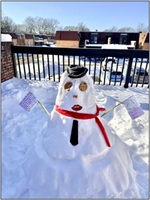 So I went outside and built a snowman.
I hadn’t built one since I was a child. Last year I named him Sam the Serenity Snowman. This year, he returned. Same name. Same purpose.
Building him wasn’t symbolic when I started. It was just living – cold fingers, packed snow, silly laughter, breath visible in the air. But afterward, I realized that this is what my higher power looks like:
Engagement with life as it is.
Presence without performance.
Joy without intoxication.
I didn’t need to explain it. I didn’t need to prove anything. I just needed to stay there.
My Religion, If I Have One
I never set out to find a religion. But one day, while sharing in a meeting, I realized something that surprised me:
This is my religion.
Not belief. Not worship.
Practice.
Step One: knowing my limits.
Step Two: choosing life.
Step Three: trusting the path and the people who help me walk it.
That realization didn’t come from study. It came from living.
Bradley had his last drink on November 22, 2021. After forty years of drinking, he entered recovery not through belief, but through necessity: if he wanted to live, alcohol could no longer be part of his life. He found his home in secular and agnostic AA, where he learned to understand higher power as life itself and recovery as daily practice. Bradley is an English teacher, writer, and lifelong learner, exploring the world, recovery, mental health, and honesty — one day at a time.
For a PDF of this article, click here: The Path that Breathes.



Good Morning from Portland, Oregon. There’s a good chance I will have 33 years of recovery tomorrow, February 9, and will be chairing my secular home group next Saturday. I’ve been looking for something to read to start my share. Bradley, thank you for telling my story (even growing up Jewish with no personal god) and for your excellent and inspiring description of the path and the practice. I can’t wait to share it with my group, to share my relationship to it and to hear how the rest of the group responds. I know it will be helpful to the newer members who are so glad to have found our secular meeting. It also will be an opportunity to mention this newsletter as well as the AA pamphlets “Many Paths to Spirituality” and “The God Word” so that new members interested in secular AA understand there is actually room here for us godless folk. I know it hasn’t always been that way. Thanks again, Bradley, for writing this and thank you, Roger, for printing.
Hello Bonnie. Thank you so much for taking the time to write this. Congratulations on nearly 33 years of recovery, and on chairing your secular home group. That’s deeply meaningful service. I’m honored that the piece resonated with you and that you plan to share it with your group, especially in a way that helps newer members feel there is room for them here. That sense of “room” has meant a great deal to me as well.
Bradley, thank you for your lovely piece of writing and engaging body of thinking. This one goes in my “keeper file”. – Jay
Hi Jay. Thank you. Knowing the piece earned a place in your “keeper file” means a lot to me. I’m glad this way of thinking resonated with you.
Thanks Bradley, I enjoyed your share.
Thanks, John. I appreciate you reading it and taking the time to say so.
Bradley.
As I clicked on the email this morning, I hardly expected to find an understanding that surpassed what I thought could ever be explained. As I have struggled mightily for the last few years with trying to understand and answer for my true self what powerlessness meant, what higher power meant and what turning my life over meant, this writing brought all that into a clarity and focus that found itself into my true self. Grateful hardly expresses this moment of an eternal experience; hoping to carry your insight into my future and into those that need this message.
Carol, thank you for this generous and deeply thoughtful response. I literally had goosebumps running throughout my body when I read your note. I’m especially moved by what you shared about wrestling with powerlessness, higher power, and turning life over. Those questions have been central to my own struggle, and I thought it felt important to put these beliefs into words. I’m grateful that the piece connected with your true self, and I hope, as you said, that whatever is useful in it continues forward into your future and to others who may need it.
Bradley, thank you so much for your lovely sharing, writing.
Everything you conveyed can be easily understood by many I think.
I’m often looking for simple, clear ways to encourage those struggling at “traditional” meetings… and for others to have some insight into those of us practising the universal wisdom principles without a deity type HP.
I am saving the pdf to reread and reflect upon.
Much gratitude for you taking the time to share. Teresa in Monterey
Thank you, Teresa. I really appreciate your words. A big part of why I wrote this was for people who feel something real in recovery but don’t connect with traditional definitions. I’m glad it resonated, and I’m honored you’re taking time to reread and reflect.
Thank you Bradley, for your beautifully explained perspective. I am sharing this with my secular group in Savannah. So many folks get stuck on hp definitions, your words, will help us get over that speedbump.
Thank you, Mary. I love how you put that: “the speedbump.” If this helps people move past the wording and back into what actually works, then I’m glad the words might help smooth that out. I appreciate you sharing it.
Thanks Bradley,
This article is a keeper!
Thanks Margarita. 😊