
AA’s Tyranny of (Other People’s) Experience

By Kurt R.
Suppose someone close to you passes away and you’re sad. A few days later you hear their voice, plain as day. You look around but the room is empty. You henceforth tell the story, “I’ve experienced things that lead me to know that death is not the end.” You’ve had a lifelong belief in souls and god and heaven, and this is strong corroborative evidence of all that.
Or you might say, “I was so devastated after so-and-so died that for a while I worried I might be getting wonky. But I got over it.” You are a materialist and “believe” in science, which tells you that aural hallucinations in the circumstances you were under are in fact quite common. The mind plays tricks. Nothing “woo woo” here.
To tell a story about what you “know” from experience, you must engage in an act of interpretation, and that essential step opens the door to an infinity of possible error. Interpretations of exactly the same raw experience can diverge radically, and the worldview of the interpreter always–always–comes along for the ride.
Science calls these stories “anecdotal evidence” and tries very hard to steer clear of them, precisely because they are so untrustworthy. In our daily lives, however, all of us create and rely on them.
* * *
The year is 1,000 or so BCE, and you are a priestly functionary in some city state near a river surrounded by desert. Your job is to predict the future by “reading” the livers of sacrificial animals–sheep and goats and cows or whatever. You’ve got this stone model of a liver with writing on it, made by your fore-priests, as kind of a manual on how to do it, plus you’ve learned your own tricks, based on long experience and training.
You’ve done this your whole adult life; your father did it, and his father did it, and on and on, and if some punk kid came up to you and asked, “Does that stuff even work, man? Because it seems kind of bogus and random…” you’d probably call the temple guards and have him roughed-up, at least a little, right there amidst the carcasses and guts, for being so disrespectful.
What a stupid question! Of course it works. Not only your own experience, but the long experience of your entire society testifies to its efficacy. Is it 100%? Well, of course not. Nothing involving mere humans is ever perfect, but any failures derive entirely from errors in implementation. And, of course, once in a while the gods change their minds. Or tell a little fib. But yeah, this sheep-liver-future-foretelling stuff works like a champ, buster, and no king with any sense would even think of going to war without it.
* * *
My first AA meeting was a profound “spiritual” experience, unbeliever though I was (and still am). I admitted to that roomful of people the shameful fact that I was an alcoholic, which simply meant to me that I needed to stop drinking but hadn’t been able to do it. They told me I was welcome and gave me a chip and a hug. I felt accepted and understood. These people had been to the same bleak place that I had come to. We shared that experience, and knew something important about each other that could be learned in no other way.
That meeting was on a Sunday night, but I would find another the following Friday, and I believe as much as I can believe anything that without that friendly, sober group of people to be around after work on Friday nights, at the end of the week, there’s no way in hell I could have kept myself out of the bars and sober. It might have been as simple as that. I needed a place to go and be accepted and feel the warmth from other people who understood why I was there, instead of the bar.
And so, yes, we shared something important, but the stories we told about it were often very different. I came into the rooms at the ripe middle age of 54 (yes, I do plan to live to at least 108) while the majority of the newcomers in that meeting were in their 20’s or 30’s. I’d raised a family and been a “respectable” member of society for decades before my always-unhealthy relationship with alcohol progressed to where I had to reach out for help. It seemed to me then and now that my experience in being The Alcoholic (a mythical beast, anyway) had to be quite different than some kid who had only been drinking legally for a year or two. Plus, I was a straight drunk, while almost all of them had “outside issues” with other substances. I also learned that the world is essentially a war zone for a large percentage of women, and especially for those who end up in recovery. To pretend that I shared a substantial part of their experience would have been laughable if it wasn’t so insulting.
Another difference was that many of them spoke of how God was doing things for them that they couldn’t do for themselves, extolling the joy of becoming passive conduits for the will of some unseen, supernatural entity. They grounded all this in stories about their experience. And I listened respectfully and enjoyed their company anyway, but didn’t for a minute take seriously the supposed “truths” they were telling me. I could certainly see the appeal of conjuring up this magical mega-person to hand things over to. It must be super nice, sometimes, to think you could sit back and let something else drive. But the thing I could never get past was, pretending it was so didn’t make it so.
It also very soon became clear that a lot of them were utterly convinced that a certain book was where The (only!) Program of AA (another chimeric critter) was laid out, and they thought very highly of it, and acted like you were foolish if you didn’t agree with them on that. At their urging, I got around to reading it fairly soon but found it underwhelming. It, too, wanted me to buy into the supernatural intervener business, and to do so based only the supposed experience of a small group of people in the 1930s. I was unconvinced, of course. By that logic, we should all be Mormons, or some such thing.
After I reached the four year mark (which I did, in the rooms and godless), I would occasionally mention that, since the main guy who wrote that book had only been on the wagon three years or so at the time, and everybody else in the group had dried out even more recently than that, their tome clearly could contain no knowledge of long term sobriety. But don’t panic, and stay tuned: I now had more credentials than they had had to write my own book. The first thing I’d do is consult a new doctor about this allergy canard, and the suspicious eye with which science viewed anecdotal evidence in general. We’d get some real data in there. And, obviously, all the god nonsense would be jettisoned. My greater experience had proven it superfluous. And experience was the rock-solid foundation. Right?
My interlocutors were less than amused. They told me that this all just proved that a) I probably wasn’t even a “real” alcoholic, and b) the Book must have been god-inspired (the insulting implication being that I was not!), and that its author(s) had merely been taking dictation.
I would continue to take a run at it now and then, but mostly just out of stubborn masochism. If–at the drop of a hat, with a straight face and an expectation of getting away with it–you could define me out of existence, plus invoke a magical omniscient super-dude to explain any apparent discrepancies, your argument guns were way bigger than mine. I had no chance of winning that showdown.
* * *
The literature of AA has the notion of the reliability of stories about experience at its very center, and so does most of the dogma that comes out of people’s mouths at meetings. But let’s get “rigorously honest” for a second: none of us really believes anything for only that reason, do we? Obviously we can’t, since for every truth supposedly derived from experience, the denial of that truth, also derived from experience, can easily be found. And it doesn’t help at all if a large number of people agree about something. We don’t let that persuade us either, as well we shouldn’t, since it’s a well-known logical fallacy (and therefore a bandwagon upon which we are ill-advised to jump).
What we do, of course, is center our own experience and biases and preconceptions, and believe the stories that reinforce those, or depart from them in a way that feels right to us. This thing of simply “taking direction” has been nonsense from the start. We follow the directions we freely assent to, and ignore–or fake–the ones we don’t. We all pick and choose.
Another thing we do because we are human is forget that this is the way we do it, and start thinking that our outlook on things is self-evident. We get around a bunch of people who do agree with us and start acting like it’s the only way to think, and laugh (or at least look askance) at anybody who thinks another way. These newcomers should listen to what we tell them, we say, in various ways, and read the book we believe in and do what it says, by gum.
Perhaps, since deep-down we know that few who are inclined to disagree will change their minds just because of our stern testimony, that isn’t the real purpose of it. Perhaps the real purpose is the old, old game of defining the doxastic boundaries of The Group and signaling to any who would dispute them to damn well keep their mouths shut. This is what we believe here. This is what defines us.
And of course we will do that while at the same time proclaiming complete openness to all views, and denouncing any desire for conformity. Only a misguided fool would disagree with us, as we have explained again and again and again and again. But we are super loving here, with minds as open as the sky. Go ahead and disagree, Friend.
When, in the rooms, I raise questions like the ones I have raised here, one of the responses I often get is something like, “Dude, we get it. You don’t have to believe anything you don’t want to. That is baked in. There is no problem here.” The subtext being, So why don’t you shut up about it, already?
And then they go right on reinforcing a culture where it takes much more courage than it should to openly express any rejection of the dogmas they espouse. I’ve experienced it too often myself, and listened to too many trauma stories, to be sold the idea that everything is fine here. I know better. Secular AA wouldn’t exist if what they say is true.
They’re right about this though: there is another tradition in AA that I would like to reinforce and extend. The My program might make you drink, Take what you need and leave the rest, This book is meant to be suggestive only, tradition. I’m well aware that it has always existed too, but I think it doesn’t go far enough, and doesn’t often speak with sufficient volume. It doesn’t usually say, My perfectly legitimate AA program doesn’t use this book at all–at least where I have heard it.
And I should be hearing it, because I know it is often true.
And with that, I’ll just take another twenty-four.
Thanks for listening.
 Kurt R. went to his first AA meeting 3/9/2014, in Ogden, Utah to prove to his daughter (who had picked him up at the jail that morning) that he meant business about stopping drinking. He has not had a drink nor any other impairing substance since. Traditional AA often rankled, and when he moved to Las Vegas in 2019, he found secular meetings. He’s been active in Secular AA for the past three years, and has recently published a novel about Las Vegas secular recovery “The Acts of Kenny Lambert” available on Amazon.
For a PDF of this article, click here: AA’s Tyranny of (Other People’s) Experience.











Belief in a higher power or God is not a requirement for AA.
The only requirement for membership is a desire to stop drinking.
If god is all powerful and all knowing and all loving wouldn’t he have prevented the suffering to begin with? If god is all of the above AND loved the little children how does he idle around allowing tens of thousands of his children to be gang raped, tortured, and killed? God helps people find a parking spot but allows children to be sexually assaulted? How does that work? I keep asking these questions to people of the cloth and all I get in return is incoherent babble. No answers which, in itself, is an answer.
Thanks, Kurt. Good article–although I had to look up the word “doxastic” 😉 . I can well imagine that you raised some eyebrows in “HP-centered” meetings. I have had to try to explain the term “freethinker” at meetings, when I’ve described myself that way.
I know it’s best to use a common word when it will do, but I can’t think of one, and it’s so easy to look up words now that I thought I’d go for it. I think it’s a very useful word once you know it. Thanks!
As happens on many Sunday mornings before “Beyond Belief” someone on aaagnostica has clearly described what I’ve been unable to vocalize or write out so effectively. And each time I want to tell them it is a perfect description and I agree completely. No way anyone could say it better. Then next Sunday someone does or from a different perspective.
For this Sunday, Kurt, your writing is the very best ever recorded describing my gradual understanding of facts on the ground. All I can do is express my enthusiasm for your description and analysis but the people at Beyond Belief in Miles City today will hear is as ho hum–there he goes again getting so abstract and preachy. Just cause he’s dying sooner, he is in a hurry to get us right (write) with the world. And I also have Heather Cox Richardson telling them they don’t really want the rich telling them what to do and think etc. There is so much to say and encourage in the next few months, but you have said it so well for this alcoholic.
Thank you.
Wow that’s high praise! It sounds like you and I are a lot alike – especially when you reference HCR. Thank you so much.
AA to a large measure has lost the plot, if it ever had it to begin with. Meetings tend to be structured, rigid, and predictable with the result of stifling spontaneity. You had best arrive with something relevant to say about the mandated topic or recycled reading even if you have to talk in cliches and platitudes. Discussing that personal issue, crisis, or anxiety that has been undermining your recovery all week, that actually may contain some value to a newcomer has to be put aside to keep AA free of anything that doesn’t relate to the forced agenda.
My weekly home group meeting calls for topics from the floor, but it’s emphasized you are free to talk on any recovery related topic you have a need to discuss. The meetings are more authentic and honest than they would be if people were forced to conform to the constraints of a forced structure. I suspect the control that exists is largely the product of an irrational fear that AA will wither and die if we ease our ritualistic behavior.
After 10 years of sobriety and being very close to the program I relapsed 5 years ago. I keep going back to AA hoping that it will work for me again. But it won’t. The blinders are off and I have to be true to myself. It really is kind of a cult and most people in there are too quick to accept whatever nonsense they are told. I just can’t keep drinking the Kool-Aid. Glad I found secular AA
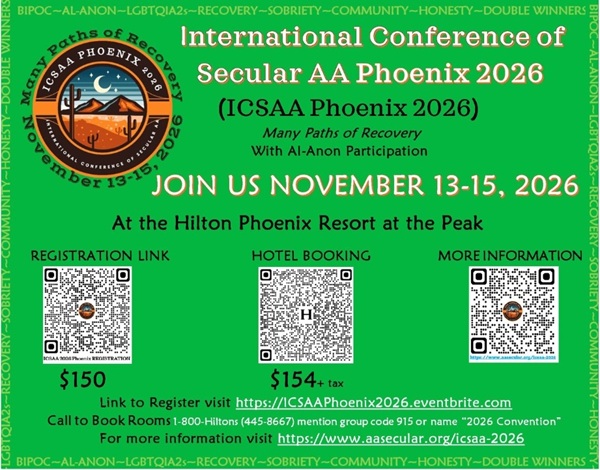
I am glad you found Secular AA too! Come and join us in Phoenix next year if you can. Google “Secular AA” and you’ll find the website with info.
What you believe or don’t believe about a higher power does not really matter. I believe that the key to staying clean and sober is to stay connected to AA and pay it forward.
What a inspiring read. Thank you. It’s nice to know others share my sentiments. When they say “you never have to be alone anymore.” This is what they mean.
Thank you so much.
Been sober for 11 years and I recently stopped attending AA meetings.
You spoke about some of the same issues that I have, the constant subtle and occasional blatant confrontations over my atheism.
In the 164 page book Alcoholics Anonymous the word “God” appears 129 times.
“He”, “Him”, “Providence” and other capitalized words referring to god appear another 129 times.
254 times god is referenced in 164 pages.
The 12 Steps are a part of a spiritual journey.
My journey taught me I didn’t believe in a deity.
I feel you! Doing a hocus-pocus-ectomy on that book is major surgery, much deeper than just swapping “god” with “group of drunks” or whatever. It’s much more deeply baked in than that. If he thought “god” could be just anything, what is the “We Agnostics” chapter about? We try to act like it isn’t so (so we can fit in and appear to play the game), but you could make a good argument that if you extract the god from that book, the only thing left is fellowship. And you don’t need a book for that.
Hey! Kurt, I had bought a copy of your book because I like the author. I didn’t realize it was a story taking place in secular recovery, too. I’m excited to start reading. See you in Phoenix, ICSAA 2026! https://www.aasecular.org/icsaa-2026
Thanks! Yes, it’s partly about secular recovery and a lot of other things as you will see when/if you read it. It’s hard to not give people too limited an idea while at the same times saying it’s about whatever a given audience is interested in. Kinda like saying Moby Dick is a fishing novel. And yeah, Phoenix or bust!!
Thanks so much, Kurt, for a multi-layered critique of AA’s current culture as you have experienced it.
The following response is my reading of what you are doing in your very Nietzschean dissection of the program.
First, what a clever way to begin your demystification of how AA works with an analogy about ancient ways of describing how things work: they “work” (sometimes) but not quite like the ancients believed. Here they had their own way of saying that God (or the gods) is/are doing for their culture what they could not do for themselves.
And then you relate to us how you cut through the various chimeras of AA doctrine and find (though not precisely in the following words) that, in reality, we are doing for ourselves what not (even) God could do for us.
But your story doesn’t end there, as we circle back to a further AA impediment: “the tyranny of the majority.”
And then you arrive at the conclusion that NOT everything is fine here in AA.
And finally, you imply that the demystification must “always, always” continue in AA, and, PERHAPS, secular AA (in all its variations) is the vehicle for this.
Enjoy your next twenty-four, Kurt.
An excellent essay. I enjoyed it a lot!
Thanks! I was worried my little journey to the past would be confusing, but of course the point is that relying on the wisdom and experience of a group or culture is no guarantee that you have arrived at “truth”–far from it–and yet that seems to be the rock-bottom basis for AA’s various dogmas, intended to silence any objections. But there are any number of past societies where the long experiential tradition seems obviously wrong-headed to us now (unless you are a modern advocate of haruspicy–which I’ll bet you can find one or two, down in Sedona, for instance). So, to say, “The group has learned the effectiveness of X from long collective experience,” doesn’t mean s_t in itself. If you want a more recent example, here’s a little story: once there was a great nation wherein a large percentage of the population came to believe that a certain clearly villainous political leader was the instrument of God’s will (“divine providence” they often called it), based on analogies that their priestly caste drew from their “Holy Scriptures.” In their minds, no evidence could argue against their beliefs–least of all science or scholarship. And it came to pass that for them, anything this leader did–however illegal or heinous–was assumed to be God’s will, and so they allowed it and even cheered for it. Disaster ensued.
The pretzel logic of the 12 steps cannot be reconciled without believing in canards that are demonstrably false. No one is powerless over alcohol; if it were so AA would not exist. And if your brain is given the latitude to select the “higher power” that supposedly will break the confining chains of addiction, then it is your brain that is the highest power in the universe. Therefore, to say one is powerless over alcohol is a nonsensical statement. There is no credible evidence that alcoholism is a “disease” and AA ludicrously promotes this fiction in every meeting. Then preposterously asserts that the God who gave you this incurable fiction will remove it if you supplicate yourself in the manner dictated by the 12 steps. If God gave you “free will”, what could be more offensive to it than throwing that free will back in it’s face, as the 12 steps command? The bonne motte “Let go and let God” is about the most blasphemous thing one can say. The 12 steps are simply a house of cards, precariously erected on a foundation of lies; and collapsible by the faintest whisper of a breeze. AA has at best a 25% success rate at the one year mark. Yet, this hocus pocus is preached in every rehab in America, save for Passages. If anyone can’t see a problem with that, they are simply denying reality.
Thank you. There is a deep incoherence in their holy text, which is inherited from Christianity, I think. These were people who saw no problems with the concepts of the Trinity, atonement theology, the incarnation (a god in a man suit ain’t no man, I say) free will in the face of divine foreknowledge, etc. That being said, I am deeply and lovingly embedded in AA culture, in spite of it’s contradictions. As long as I can argue and advocate for change, I’ll stay sober and be reasonably happy in it 🙂
Love the piece. Envious, in fact. I’m working my own project along these very lines. I fear I won’t be as clear. Oh, my I hope GOD will help me with that. You may note it is letting go of my sarcasm that will actually help.
I replied at this comment because you really hit home with me on this point. I, too, know the realities of AA and, like you hope to bring change. In my 37 years I have been dedicated to the ‘plot’ as someone commented. What’s at the heart and attainable for anyone: fellowship with the common goal of sobriety. While I prefer Secular AA meetings, I do remain in the “culture” as you put it. I will say it does seem increasingly difficult to “argue and advocate” and stay reasonably happy. Your efforts in that has renewed my own, efforts I have been making since I was six months sober. I get what prompts you to stay embedded so I “Nodded my head knowingly” as you “shared” I actually say this sincerely, “thanks for sharing” I needed that.
It is a useful fellowship and nothing more. The ridiculous notion that there is something magical about AA is just another expression of the denial of reality. There were only six steps revealed in Bill W’s delirium anyway, I was kicked out of my group, not because of any dispute about God, but because I dared to question the stubborn adherence to orthodoxy. I objected when the group’s elder statesman pronounced: “A drug is a drug is a drug”, when he had never tried any of them but booze. I offered to publicly debate him on the staleness of the heterodoxy. He refused. While he spent most meetings playing with his cell phone; though I periodically caught him and shamed him with a wagging finger. You don’t have to accept my premise that AA’s suborn adherence to orthodoxy is damaging; Bill W. said basically the same thing in his 1952 address to the General Congress of AA. Worth a read. If you want proof the program is shit, you need only observe that every rehab has a separate relapse unit. They await your failure and the opportunity to zap your insurance for another $25,000. Just to feed you the same gobbledygook one more time.