
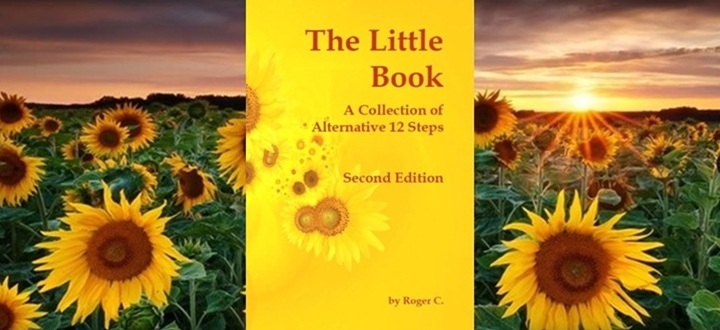
The Little Book
By Roger C.
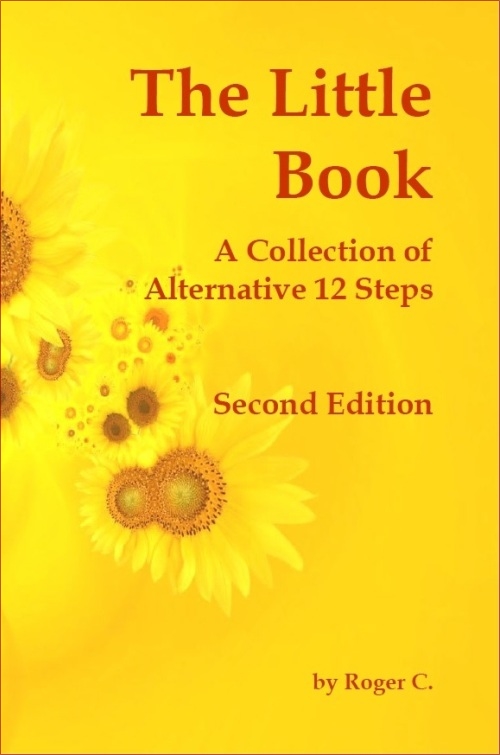
The very first book I published was The Little Book: A Collection of Alternative 12 Steps. It was published in 2012, some thirteen years ago. And a second edition was published in 2020, just five years ago.
Why did I publish it? Well, because I couldn’t stand The Big Book, Alcoholics Anonymous. That book, published in 1939, has the 12 Steps and a God (or Him) is in six of them. So, you need a God to do the Steps and stay sober? I have a BA and an MA in Religious Studies and I don’t believe in a God.
The Little Book contains twenty versions of the 12 Steps, and most of them are secular versions. Here are two of them.
Humanist Twelve Steps
B.F. Skinner, a researcher and writer at Harvard University, drafted these Steps.
Published in 1987.
1. We accept the fact that all our efforts to stop drinking have failed.
2. We believe that we must turn elsewhere for help.
3. We turn to our fellow men and women, particularly those who have struggled with the same problem.
4. We have made a list of the situations in which we are most likely to drink.
5. We ask our friends to help us avoid those situations.
6. We are ready to accept the help they give us.
7. We honestly hope they will help.
8. We have made a list of the persons we have harmed and to whom we hope to make amends.
9. We shall do all we can to make amends, in any way that will not cause further harm.
10. We will continue to make such lists and revise them as needed.
11. We appreciate what our friends have done and are doing to help us.
12. We, in turn, are ready to help others who may come to us in the same way.
The Practical 12 Steps
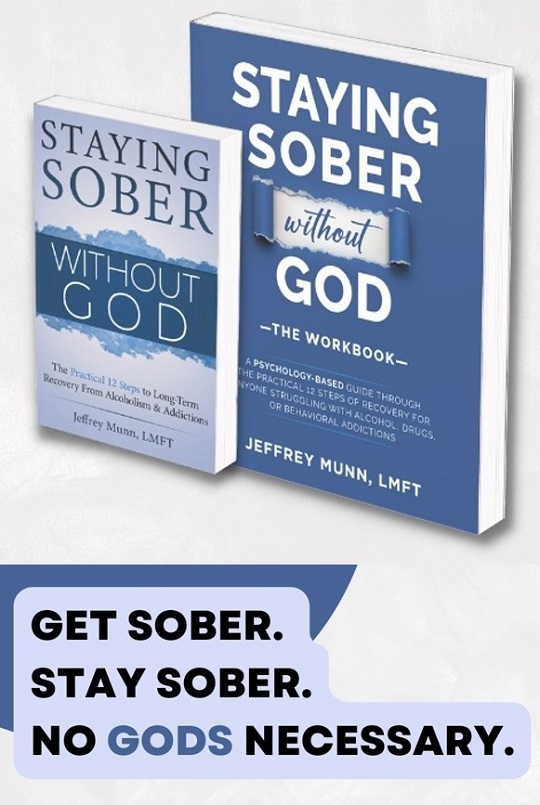
Jeffrey Munn is the author of Staying Sober Without God.
Published in 2019.
1. Admitted we were caught in a self-destructive cycle and currently lacked the tools to stop it.
2. Trusted that a healthy lifestyle was attainable through social support and consistent self-improvement.
3. Committed to a lifestyle of recovery, focusing only on what we could control.
4. Made a comprehensive list of our resentments, fears and harmful actions.
5. Shared our list with a trustworthy person.
6. Made a list of our unhealthy character traits.
7. Began cultivating healthy character traits through our consistent positive behavior.
8. Determined the best way to make amends to those we had harmed.
9. Made direct amends to such people wherever possible, except when to do so would cause harm.
10. Practiced daily self-reflection and continued making amends whenever necessary.
11. We started meditating.
12. Sought to retain our newfound recovery lifestyle by teaching it to those willing to learn and by surrounding ourselves with healthy people.
After the 20 versions of the 12 Steps The Little Book has four interpretations of each of the 12 Steps.
These are very good interpretations, made by:
Dr. Allen Berger, the author of several books including 12 Smart Things to Do when the Booze and Drugs Are Gone;
Stephanie Covington, author of A Woman’s Way Through the Twelve Steps;
Gabor Maté, the author of several books, the most recent being The Myth of Normal and
Thérèse Jacobs-Stewart, author of Mindfulness and the 12 Steps.
Here are their interpretations of Step 4 (The original: “Made a searching and fearless moral inventory of ourselves”).
Allen Berger: The essence of this Step involves increasing our self-awareness, self-honesty, and insight into our behavior.
Stephanie Covington: When we carry intense guilt, we can hardly bear the thought of reviewing our past deeds. It may feel too painful to think about how we have hurt others and hurt ourselves. It was a revelation to discover that Step Four wasn’t just about agonizing about my past. Instead it was about getting to know myself better.
Garbor Maté: The idea here is not self-condemnation, but the preparation of a clean slate for a life of sobriety. We search our conscience to identify where and how we have betrayed ourselves or others, not to wallow in guilt but to leave ourselves unburdened in the present and to help clear our path to the future.
Thérèse Jacobs-Stewart: In Step Four we are asked to look at parts of ourselves we are uncomfortable with, the parts that we reject and keep hidden out of fear or shame.
Finally, The Little Book ends with an article about “The Origins of the 12 Steps”. Here is how it begins:
It all began in the waning months of 1934.
Bill W., an incorrigible inebriate nearing the end of his rope, was visited at his home by Ebby T., a former schoolmate and friend. Ebby was no stranger to alcohol and had done time in jail and mental hospitals to prove it.
Bill expected to spend the day drinking and reliving old times with his friend, but Ebby would have none of it. He had found sobriety and wanted instead to share his “experience, strength and hope” with Bill. “On a chill November afternoon in 1934 it was Ebby who had brought me the message that saved my life,” Bill would later say in his eulogy to his old friend.
But that salvation was not quite immediate. Waving a bottle of beer, Bill staggered up the steps of the Towns Hospital for Alcohol and Drug Addiction for his fourth and last time on the afternoon of December 11, 1934. Ebby visited him there on December 14 and once again carried his message of sobriety to his friend. Bill never drank again after Towns Hospital and understood that the experience of “one alcoholic talking to another” had been the key to his sobriety.
Indeed, four months later Bill would carry the message to another alcoholic. On a business trip to Akron, Ohio, afraid he might relapse, Bill arranged a meeting with Dr. Bob S. It certainly was an experience of one alcoholic talking to another. Dr. Bob had insisted the meeting be limited to 15 minutes but was so moved by Bill’s understanding and the fact that he shared from his own personal experience that the discussion lasted six hours.
Bill stayed at Dr. Bob’s home working with him from May 12 to June 10, 1935, when Dr. Bob took his last drink.
Bill and Dr. Bob, of course, are recognized as the co-founders of Alcoholics Anonymous. And June 10, 1935, is generally considered the founding date of AA – an acknowledgement that “in the kinship of common suffering, one alcoholic talking to another” would forever be the fundamental principle of the fellowship of AA.
 Well now that’s it! Of course, The Little Book has much, much more information about the 12 Steps, the interpretations of each of the Steps and the origins of the Steps. That’s very true, even though The Little Book ends after a total of 65 pages.
It’s a popular book and is available at Amazon USA. It is also available via Amazon in Canada and the United Kingdom and, well, several other continents and countries. It is, of course, also available as a Kindle.
Thank you for reading this article!
For a PDF of this article, click here: The Little Book.






The little book has been a well used resource.
Thanks for your ACTION.
Thanks for the review Roger. Wish I felt inspired enough to write an article for possible inclusion in aaagnostica.
I have had ‘The Little Book’ for years and it’s a tremendous resource. I would love to see a Stoics alternative or a CBT or DBT alternatives. Are you aware of any steps using these sources?
I wonder whether there might be value in not trying to have ‘12-steps’ as it’s only a number after all? Might free us up to only describe what needs to be described, etc.
Grateful for your (my) “The Little Book.” We Free Thinkers who’ve left tradiononal AA rooms, now in increasing numbers, are finding strength and hope beyond the AA BB. Sadly, Abby T. succumbed to his AUD. Your book may have released him from the AA BB dogma and the belief in AA that AUD is a lifelong disease where we can never get out of the AA lifeboat, out of the AA rooms.
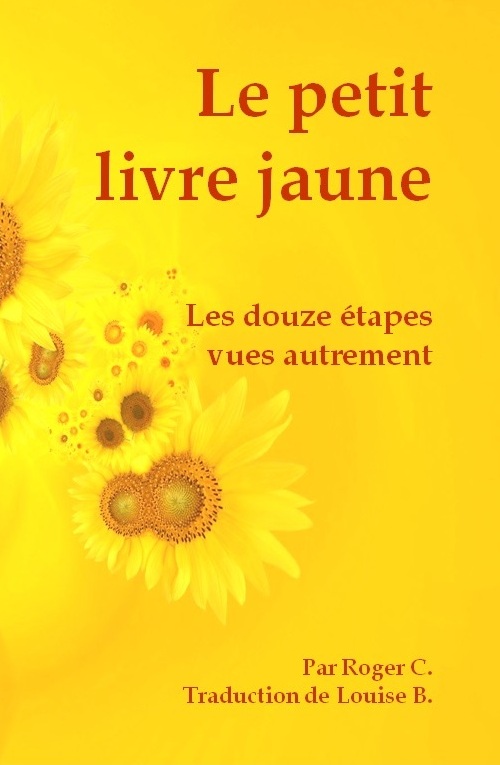
And it has also been translated into French as Le petit livre jaune.