
An Agnostic’s AA Journey
By Mikey B.
I thought that having to go to AA was a bad thing; it turned out to be the best thing to happen in my life. It was an important turning point. I also thought that the Covid19 pandemic was a bad thing, but because of it, many AA meetings decided to go online. The pandemic greatly accelerated online meeting acceptance. I can now attend meetings anywhere in the world, using my computer or even just my phone. During the last four years, I have discovered more AA meeting choices online, including secular. I’ve attended meetings in the US, Canada, the UK, Europe and Australia. Most of these meetings I discovered on the World Wide Secular Meetings site www.worldwidesecularmeetings.com.
I love these online secular AA meetings. Secular meetings don’t have prayers, and are more inclusive, without regard to a person’s belief or non belief. I felt much more honest and authentic not having to pretend to believe. Through secular meetings, I discovered that many other members have similar difficulties with the God part of the AA program. I now have renewed enthusiasm for continued participation in AA. What a joy it was to attend the in-person International Conference of Secular Alcoholics Anonymous (ICSAA) Conference in Orlando, Florida, last September. I actually met AA members face to face, after going to online meetings with many of them for more than three years.
Prior to AA, I had no idea what alcoholism was. I always considered an alcoholic to be someone whose drinking was worse than mine. I usually had someone I could point down to as worse than me, but as time passed I continued to experience more problems and “YETS” (You’re Eligible Too). By this time in my life I had a little alcohol education from some of the court-ordered programs I participated in, and I had begun to recognize the progression of my drinking.
I think I was born an alcoholic. My first experience with alcohol was camping out with the Cub Scouts. One evening, two other scouts and I passed around a bottle of booze. I vividly remember that feeling of “ease and comfort” coming over me, as Dr. Silkworth describes it in “The Doctor’s Opinion” of the Big Book. The good doctor also describes the alcoholic as being restless, irritable and discontented. I had felt this way for as far back as I can remember. Alcohol soothed me, and became my answer for several years.
I drank through my teens and into my early twenties. As a consequence, I had many run-ins with the law. I appeared in court several times for being a minor in possession, for stealing alcohol, and for DUIs. I wrecked my car, I lost a job, I ended up in the hospital a few times, and I nearly died in a serious motorcycle accident. I felt like such a loser. During one of my many low points, I joined the Marines in an attempt to to get my life on track, but I failed at that and was discharged from boot camp. In the last few years of my drinking, I drank more and my problems accelerated. I tried to stop drinking, but I could not stay stopped.
With a court card, I walked into my first AA meeting in January of 1980, after being dry for two months, then slipping on New Year’s Eve. I was 22 years old and defeated. Why did I drink the way I did? Why couldn’t I stay stopped?
I didn’t know what to expect at that meeting. I’d been told these AA people talked a lot about God and reminisced about their drinking days. I didn’t see how this would help me. But once I sat in an actual meeting, and the sharing began, my mind started to calm and my anxieties lessened. I soon felt the hope that sobriety was possible, and that it might be worthwhile. I wasn’t sure yet if I was an alcoholic, that would take a few more meetings.
At that first meeting, I remember hearing other people’s experience (H.O.P.E.) of their drinking, their difficulties dealing with life, and how they ultimately found their way to a meeting and sobriety.
One man, a construction worker, shared “One is too many and a hundred isn’t enough.” A lady described her loneliness as her drinking quickly accelerated. Another man described the progression of his drinking, from a shy and awkward teen to a homeless wino. I recognized the similarities to my own drinking in their stories, and began to realize what my future would be if I continued drinking.
Then, as today, mainstream AA meetings sometimes start and usually end in prayer, with everyone standing up and holding hands. This practice made me feel very uncomfortable. It still does. I especially disliked reciting the Lord’s Prayer, which brought back memories of my religious Catholic childhood, which I rejected in my early teens.
Early on, desperate to be accepted and in an effort to fit in with the AA membership, I paid close attention to what I heard in meetings, in order to say the right things. After overhearing a man say that he was an atheist, and then hearing members tell him that he would need to find God to stay sober, I learned to be quiet about my doubts and disbeliefs. I noticed which shares got the approval of the group. I started talking the talk and getting the approving nods.
I acted as if there was a God, although I didn’t believe in one. I started working steps. I hoped that with an open mind, I would get this program and be able to stay sober. But feelings of inadequacy and confusion flooded me during meetings. Was it because my dyslexia kept me from properly understanding what was read? Was I too self- obsessed and prideful to realize I needed a God to help me? What was I doing wrong? Why couldn’t I get God?
Luckily, I got involved in service early on. Doing service work felt authentic, and I felt like a contributing part of the group. My conflict over faith was irrelevant. Over the years, I’ve held many positions at the meeting, group, district and area levels. Recently I was part of the committee for the 2024 ICSAA (International Conference of Secular AA). I also sponsor members and drive an old-timer to meetings.
The idea of “take what you need and leave the rest” helped in the beginning. For many years I had to ignore, filter and translate what I was hearing in meetings to something I could use. I always worried my program was missing something. Reading “How it Works” at the beginning of meetings began to upset me, especially the words: “half measures availed us nothing.” I feared that my step work was lacking in those God steps, and “God” or “Him” appears in half of the steps. I always had the anxious feeling of missing the spiritual part and that someday I might drink because of that.
Looking back, I worked the first of those God steps pretending that there was a God. By the time I got to steps 6 and 7, however, I firmly believed there was no God to remove character defects. By then, after years of sobriety, I knew it was solely my responsibility.
Many times, over the years, I’ve thought of quitting mainstream AA, because of the emphasis on a higher power. As I read the Big Book and attended many Big Book and 12×12 study meetings, I silently questioned the steps and the 281 references to God in the first 164 pages. Chapter 4 “We Agnostics” seems to insist that one must find God to be restored to sanity – I couldn’t disagree more. It is really just an attempt to convert nonbelievers. Aside from that, there is a lot of helpful information for developing a program for living in the AA literature.
At 36 years sober, I searched the internet for “agnostics in AA,” and found others with the same experience and doubts as me. But there were no secular meetings listed for the Central Coast of California, my home. I also learned that two years earlier there had been a Conference for Agnostics and Atheists held in Santa Monica, just a three hour drive from my home. I was sorry to have missed that.
Over the next couple of years, I attended a few Agnostics And Freethinkers meetings in San Francisco. Through further internet searches, I discovered blogs, books and podcasts of agnostics in recovery. I’ve listened to hours of the Beyond Belief Sobriety Podcast beyondbeliefsobriety.com, and I’ve discovered AA Agnostica, at aaagnostica.org. I’ve read many personal stories of AA agnostics, and have found literature to buy. These held my interest.
Then, at 40 years sober, I found the “God Word” pamphlet, which encouraged me that I could stay in AA without a belief in a higher power. I renewed my search for agnostic AA meetings. At the end of February, 2020, just before the pandemic, I attended a secular meeting about 30 miles from where I lived. When the pandemic shut live meetings down, I started joining meetings online. I first attended mainstream AA meetings, then I eventually found the secular meeting list www.worldwidesecularmeetings.com with more than 500 meetings, opening the door for me to connect with many other atheists, agnostics and freethinkers.
As I reflect back on my 45 years of sobriety in AA, my two most important actions are my commitment to abstinence (don’t drink no matter what) and my continued contact and service with other sober members. I learned this through AA, and for this, I am so grateful. If, like myself, you have considering quitting AA because of its emphasis on a higher power, perhaps it’s time to look for a different meeting. I did, I found my tribe, and I’m finally comfortable and authentic.
Mikey B had his last drink on January 17, 1980. After multiple DUIs, a nudge from the judge sent him to AA which, despite his agnosticism, has helped him to stay sober for 45 years. He drives 45 minutes to San Luis Obispo to co-secretary the Agnostics and Others meeting, his only in-person secular meeting. For secular support, he attends secular meetings online and reads websites such as AA Agnostica. In-person mainstream meetings are currently the only option in Santa Maria, his hometown. In the few mainstream meetings he attends, he connects with and encourages others struggling with the same difficulties he has had, especially as an agnostic in AA. Recently retired, he and his wife Shirlee (sober 41 years) enjoy travelling, most recently to Greece. He hopes to see Secular AA grow on the California Central Coast.
For a PDF of this article, click here: An Agnostic’s AA Journey.






Well said. I absolutely relate to so many of the points and the early portion of Mikey’s sobriety journey. There are no secular meetings where I currently live but we’re moving to a place where there are several. Meanwhile I’m trying online meetings, too. 28 months so far, one day at a time.
Martin, thank you. 28 months, well done!
And a better member you can not meet. I am not suprised to see you here. To know eachother forever and today learn we are more alike again. I value your sobriety and your JOY in life.
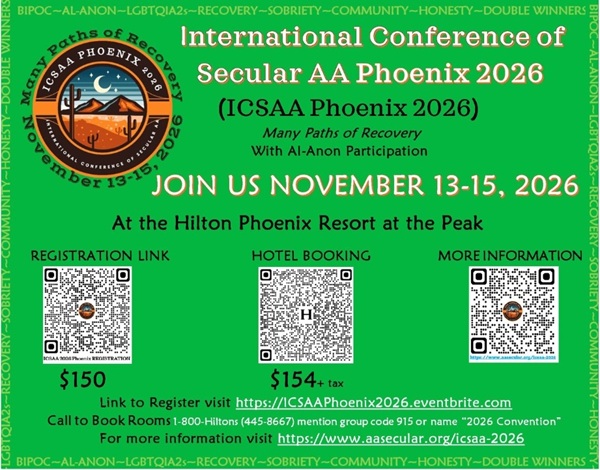
Marita! Thank you. Through the years, you have shined as an inspiration and example, especially in your service to AA. I hope to see you at the ICSSA in-person conference in Phoenix in November of 2026.
That is wonderful Mikey. I have heard you speak multiple times, but have not heard this part of your sobriety. It sounds like you have found your way to true serenity and happiness. We have been friends for a long time and will continue to be friend. Continue to live happily ever after.
Thank you Helga.
LOVE IT!
Thank you Ron.
Mickey, thank you for your share. For my self, after a number of years of being a coffee maker and ashtray cleaner (when lots smoked in meetings) secretary and GSR and DCM largely in LA, but also in Biloxi Mississippi where my long-term meeting format featured a number of prayers. We had a business meeting. I suggested that that our format might be somewhat off-putting to some but no one agreed with me. So, another AA member and I contacted New York and got a meeting number and we now have a We Agnostics meeting in Biloxi that is incredibly sparsely attended though we have made do for the last six years or so. Though hardly a well attended venue, our prudent reserve now sits at $82. But for me and those who occasionally attend, I find it is more than rewarding.
Thank You Eugene.
I’ve been told that our Agnostics and Others meeting is at least 10 years old. We meet once a week on Saturdays. The meeting went online through the pandemic until this past December, attendance dropped to 2 or 3 and our host died. Our in-person meeting restarted sometime in 2022. Yesterday we only had 6 people, a couple of weeks ago it was 3. The most we have had was 13. Currently the groups focus is to keep the in-person meeting going. Keep those doors open Eugene. We occasionally get out of town visitors or people specifically searching for non-religious meetings and it makes my day to meet more of us.
Wow! I’m in Biloxi and never knew about this AA option. Thank you!
Thank you for this account of your journey. I relate to so much of what you went through learning sobriety in the non-secular meetings. I found that I had to face that I couldn’t just go along with the religious stuff, I had to be honest with myself and admit that I didn’t believe in gods or higher powers. I had gone from the fantasy life of my drinking and it seemed like I was being encouraged to pick up a fantasy life with supernatural deities. It was a matter of standing in the prayer circle but not reciting, saying no when asked to read the religious readings and just simply saying I don’t believe that stuff. I have 37 years of continuous sobriety. AA works without the god stuff.
Thank you Doris.
We are not alone – I will say the serenity prayer but start it with “I seek” instead of god.
I live in a old school AA area and hear all the god bullshit at almost every meeting. I’m very vocal about being an atheist in the rooms of AA… I see people who conform instead of speak up about their true beliefs… I want all atheists to be comfortable in the rooms of AA… I have to be that voice that let’s newcomers know it can be done.
I was always told to be who I need to be to stay sober… Not who they tell me I should be.
Thank you Tim.
Do Tell. For many years I was Don’t Tell. Perhaps borne of a fear that I might be ostracized by the group. Today I am more focused on how to articulate my experience, strength and hope in any meeting I attend to help that suffering alcoholic that has difficulty with the program.
Thank you, Mikey! Going online is how I found the San Louis Obispo group. It was always a pleasure to see y’all on Sunday nights. And, equally great to meet you in Orlando.
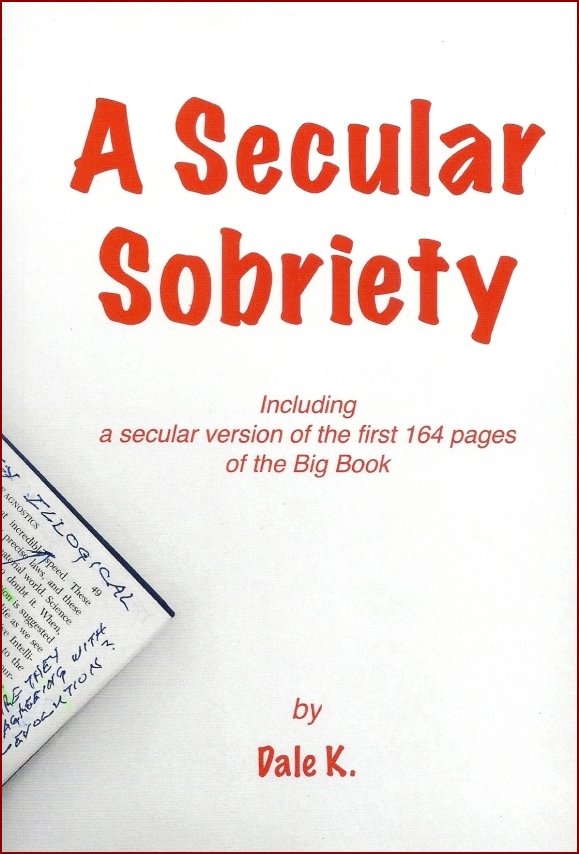
Thank you Dale! I just reread your article “ICSAA 2024 Essay” on this website. Good read. It was great to spend time in Orlando just talking about our experiences and our recoveries. The Long Timers panel had a mix of different experiences with members from different parts of the country. Penny was very funny. I just recently reread Chapter 5 “How It May Work” from your book “A Secular Sobriety,” I particularly like what you had done with the A,B,Cs. (a) That we were alcoholic and could not manage our own lives (b) That probably no amount of will power could have relieved our alcoholism (c) That fellowship and a profound change of thinking could and would if it were sought. It is always good to see you online at a meeting and I hope to see you in Phoenix November 2026 for the next ICSAA in-person conference.
Good evening, Mikey. Thank you for sending your pitch. You have a lot to share and share it well and in depth. The more I get to know SHIRLEE and you the bigger my heart grows towards both of you. Grateful we’re getting to know each other through the years. Keep on doing the good work.
Blessed for the three of our friendships. Have a blessed evening.
Thank you Mary Ann.